
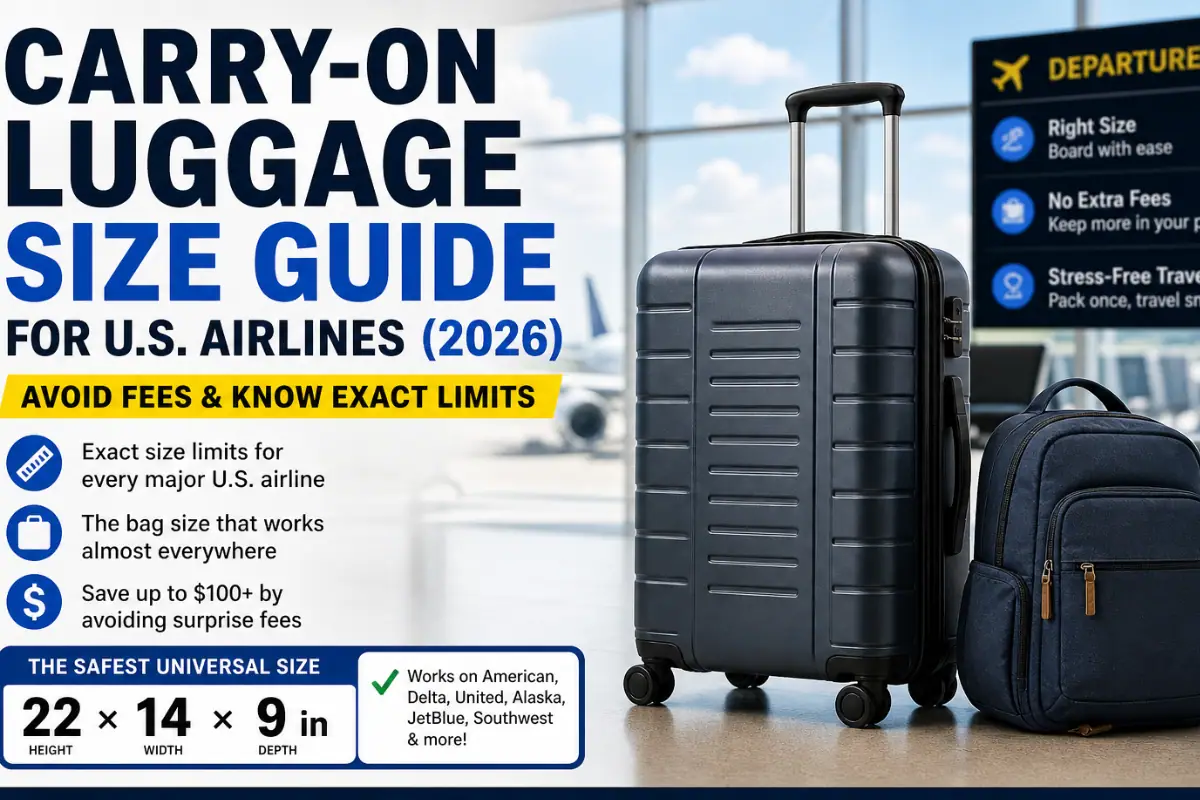
Real size limits. Verified from official airline pages. So you pack once and board without stress.
You’re at the gate. You’ve got your boarding pass pulled up, shoes back on after security, and you’re ready to go. Then a gate agent flags your bag. It’s too big, or it turns out carry-ons cost extra on the airline you booked — and you had no idea.
That $49 flight just became a $149 flight. And it’s one of the most common — and most avoidable — travel mistakes.
This guide gives you the exact carry-on luggage size limits for every major U.S. airline, a bag size that works almost everywhere, the real story on budget airline rules, and the packing habits that let you skip bag fees entirely.
Related Guides
- What is The Max Safe Personal Item Standard? Definitive 2026 Guide.
- IndiGo Baggage Guide 2026: How to Beat the 7kg Rule Legally.
- The 7 Best Under-Seat Bags (Personal Item Size) | Tested on 20 Airlines.
What Size Carry-On Fits ALL U.S. Airlines?
If you only read one thing in this guide, let it be this. There’s one carry-on size that clears gate checks on virtually every U.S. carrier:
The Safest Universal Carry-On Size 22 × 14 × 9 in
Works on American · Delta · United · Alaska · JetBlue · Southwest & more
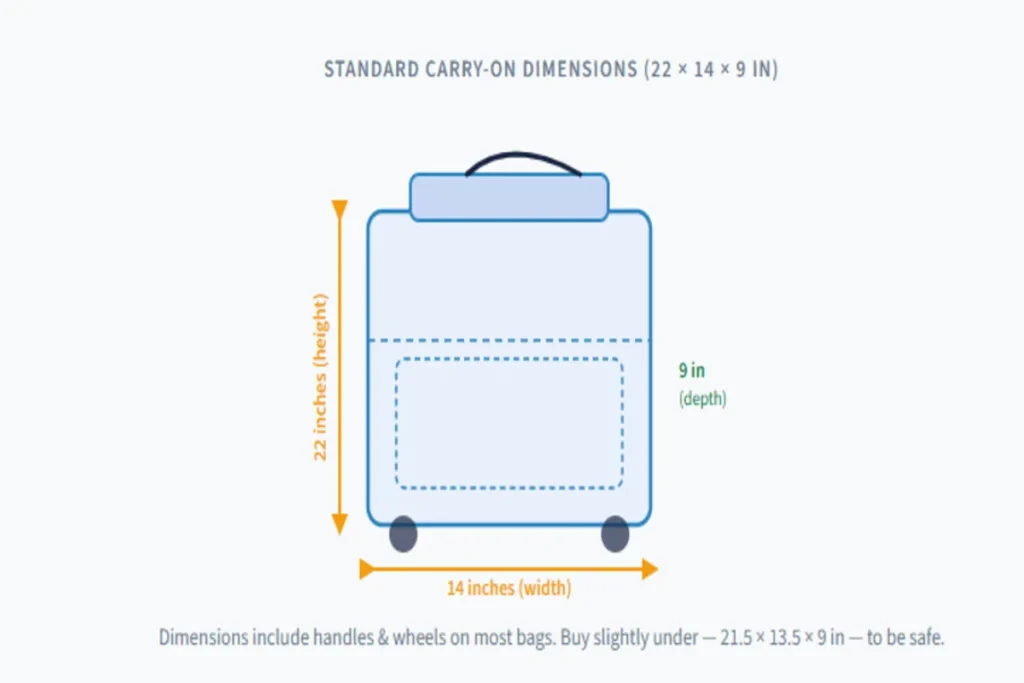
A bag at this size passes on American, Delta, United, Alaska, JetBlue, and Southwest — with no questions asked. Southwest’s limit is actually bigger (24 × 16 × 10 in), so you have even more breathing room there.
Budget carriers Spirit and Frontier allow large carry-ons, but they always charge extra for overhead bin access, regardless of your bag’s size. The size rules don’t save you from the fee.
2026 U.S. Airline Carry-On Size Comparison Table
This table is pulled from official airline baggage policy pages and was verified in April 2026. Use it to look up your airline before you pack — especially the personal item column if you’re on a budget carrier.
| Airline | Personal Item | Carry-On | Weight Limit |
|---|---|---|---|
| Alaska Airlines | Not specified (must fit under seat) | 22 × 14 × 9 in | — |
| Allegiant Air | 18 × 14 × 8 in | 22 × 16 × 10 in | — |
| American Airlines | 18 × 14 × 8 in | 22 × 14 × 9 in | — |
| Avelo Airlines | 17 × 13 × 9 in | 22 × 14 × 9 in | — |
| Breeze Airways | 17 × 13 × 8 in | 22 × 14 × 9 in | 35 lbs |
| Cape Air | Max 36 linear in | Max 45 linear in | — |
| Contour Airlines | 17 × 10 × 9 in | 22 × 14 × 9 in | — |
| Delta Air Lines | Not specified (under-seat fit) | 22 × 14 × 9 in | — |
| Frontier Airlines | 18 × 14 × 8 in | 24 × 16 × 10 in | 35 lbs |
| Hawaiian Airlines | Not specified (under-seat fit) | 22 × 14 × 9 in | 25 lbs |
| JetBlue Airways | 17 × 13 × 8 in | 22 × 14 × 9 in | — |
| Southwest Airlines | Not specified | 24 × 16 × 10 in | — |
| Spirit Airlines | 18 × 14 × 8 in | 22 × 18 × 10 in | 40 lbs |
| Sun Country Airlines | 17 × 13 × 9 in | 24 × 16 × 11 in | 35 lbs |
| United Airlines | 17 × 10 × 9 in | 22 × 14 × 9 in | — |
* “Most fares” excludes Basic Economy on American, Delta, and United — those tiers restrict passengers to a personal item only. Always confirm on the airline’s site before you travel.
U.S. AIRLINES ONBOARD LUGGAGE SIZE GUIDE
There are few things more stressful than standing at the gate, watching a staff member eye your bag as it owes them money. Whether you’re a seasoned road warrior or gearing up for your first solo trip, knowing exactly how big your carry-on can be — before you leave the house — saves you time, money, and a whole lot of anxiety.
We’ve broken down the carry-on and personal item size limits for every major U.S. airline in one place. No vague disclaimers, no outdated screenshots — just the numbers you need.
Personal item vs. carry-on: what’s the difference?
If you’re new to flying, these two terms trip people up all the time.
A personal item is your smaller bag — a tote, laptop sleeve, small backpack, or purse — and it goes under the seat in front of you. Here’s the catch most people miss: if you’re already carrying a purse or belt bag, that counts as your personal item. You can’t board with both a purse and a backpack and call them separate things.
A carry-on is the larger bag that goes in the overhead bin — typically a rolling suitcase or a full-size travel backpack. This is separate from a checked bag, which you drop off at the check-in counter before security and pick up from the baggage carousel upon arrival.
One more thing before you measure: always include wheels, handles, and any frame hardware in your dimensions. What counts is the bag’s full outer footprint, not just the fabric shell.
Carry-on size limits by airline
Most U.S. airlines allow one personal item plus one carry-on per passenger. Where fees or weight limits apply, we’ve flagged them.
Alaska Airlines
- Personal item: No official size limit — just needs to fit under the seat
- Carry-on: 22″ × 14″ × 9″
Alaska is unusually relaxed about personal item dimensions, which gives you some flexibility. The one thing to watch: if your flight operates on older Horizon Air turboprop aircraft, the overhead bins are much smaller than on a standard jet, and your carry-on may need to be gate-checked.
Allegiant Air
- Personal item: 8″ × 14″ × 18″
- Carry-on: 10″ × 16″ × 22″
Allegiant operates as a budget carrier, so plan on paying extra for anything beyond your one free personal item. If you can squeeze everything into a bag that fits under the seat, you’ll save yourself a gate fee.
American Airlines
- Personal item: 18″ × 14″ × 8″
- Carry-on: 22″ × 14″ × 9″
As the largest U.S. carrier, American has a wide regional network operating under its banner — including Envoy, Piedmont, PSA Airlines, Republic Airways, and SkyWest.
The same baggage rules apply across partners, but smaller regional planes may not have room for a full-size carry-on, and you could be asked to gate-check it (you’ll get it back at the jet bridge when you land).
Avelo Airlines
- Personal item: 17″ × 13″ × 9″
- Carry-on: 22″ × 14″ × 9″
Avelo is a younger ultra-low-cost carrier with some quirky policies worth reading up on before you fly. When it comes to bag sizes, though, their limits align with the industry standard.
Breeze Airways
- Personal item: 17″ × 13″ × 8″
- Carry-on: 22″ × 14″ × 9″
Another budget-friendly option. As with most low-cost carriers, packing everything into a personal item is the smartest way to avoid extra charges.
Cape Air
- Personal item: Max 36 linear inches (length + width + height combined)
- Carry-on: Max 45 linear inches (length + width + height combined)
Cape Air operates small charter aircraft, so the rules work differently here — dimensions are measured as total linear inches rather than individual sides.
More importantly, not every Cape Air plane has overhead bins or under-seat storage, so check your specific aircraft before you assume you can bring a bag on board.
Contour Airlines
- Personal item: 9″ × 10″ × 17″
- Carry-on: 22″ × 14″ × 9″
Contour flies compact regional jets out of smaller markets in the southeastern U.S. Overhead space is limited on these aircraft, so gate-checking your carry-on is common — factor that into your travel time if you’re making a connection.
Delta Airlines
- Personal item: No set dimensions — described as “a purse, laptop bag, or item of similar size” that fits under the seat
- Carry-on: 22″ × 14″ × 9″
Delta leaves personal item sizing deliberately vague, which means it comes down to judgment at the gate. Stick to something clearly in the laptop bag or small backpack range, and you won’t have any issues.
Regional partners like Endeavor Air, Republic Airways, and SkyWest operate under Delta’s umbrella — their bag rules apply, but gate-checking is possible on smaller planes.
Frontier Airlines
- Personal item: 14″ × 18″ × 8″
- Carry-on: 24″ × 10″ × 16″
- Carry-on weight limit: 35 lbs
Frontier is one to watch carefully. Gate agents are reportedly incentivized to charge passengers whose bags don’t pass the gate sizer — so measure your bag at home, not just eyeball it.
Their carry-on dimensions are also a little unconventional (notably narrow at 10″), so don’t assume a bag that fits another airline will automatically pass here.
Hawaiian Airlines
- Personal item: No set dimensions — must fit under the seat in front
- Carry-on: 9″ × 14″ × 22″
- Carry-on weight limit: 25 lbs
Hawaiian has one of the industry’s strictest weight limits at just 25 lbs — lighter than most travelers expect. Pack accordingly, especially if you’re loading up on gear for outdoor adventures or stocking up on gifts to bring home.
JetBlue
- Personal item: 17″ × 13″ × 8″
- Carry-on: 22″ × 14″ × 9″
JetBlue has leaned further into budget carrier territory in recent years, but its baggage policy remains straightforward and reasonably generous. No weight limit on carry-ons is a welcome plus.
Southwest Airlines
- Personal item: Any bag that fits under the seat — no dimensions published
- Carry-on: 24″ × 16″ × 10″
Southwest keeps things relaxed when it comes to personal items — their rule is that it must fit under the seat. Their carry-on allowance is actually on the larger side compared to many competitors.
What really sets Southwest apart is that checked bags still fly free, which changes the calculus for travelers who are debating whether to pack light or check a bag.
Spirit Airlines
- Personal item: 18″ × 14″ × 8″
- Carry-on: 22″ × 18″ × 10″
Spirit has a reputation — and some of it is earned. That said, they’re at least transparent about what you’re getting into.
Carry-on bags come with an additional fee on top of the base fare, so if you’re trying to keep costs down, the free personal item under the seat is your best friend.
Spirit’s carry-on is wider than most at 18″, which can actually work in your favor if you pack the right bag.
For a complete breakdown of exact dimensions, packing examples, and what actually fits without paying extra fees, see our full guide on Spirit Airlines Personal Item Size 2026: Exact Dimensions, Free Bag Rules & What Fits.
Sun Country Airlines
- Personal item: 17″ × 13″ × 9″
- Carry-on: 24″ × 16″ × 11″
- Carry-on weight limit: 35 lbs
Based out of Minneapolis-Saint Paul, Sun Country has one of the more generous carry-on allowances by dimensions. The 35 lb weight limit is worth noting if you tend to pack heavy — it’s stricter than what most airlines allow.
United Airlines
- Personal item: 9″ × 10″ × 17″
- Carry-on: 9″ × 14″ × 22″
United’s personal item limit is on the tighter side — only 9 inches deep — so if you’re hoping to squeeze a bulky laptop backpack under the seat, measure first.
United operates one of the largest regional networks in the country through partners like GoJet, Mesa Airlines, Republic Airways, and SkyWest. Note that CommuteAir flights only permit a single personal item — no carry-on at all.
A few things worth knowing before you pack
Always measure your bag fully packed. A soft-sided bag that fits the limits when empty might not once you’ve stuffed it — fabric stretches and pockets bulge. Stuff it first, then measure.
Budget carriers mean business about bag sizes. Airlines like Frontier and Spirit are known to use bag sizers at the gate. If your carry-on doesn’t fit, you’ll pay a gate fee that’s typically higher than what you’d pay online. It’s not worth the risk.
Consolidate before you board. If you’re carrying a purse and a backpack, that’s two bags. Most airlines allow one personal item plus one carry-on — not two personal items. If you want to bring both, one needs to fit inside the other before you get to the gate.
Gate-checking isn’t always bad. On regional flights with small planes, the crew often asks passengers to gate-check carry-ons because there’s no overhead bin space. Your bag goes in the cargo hold and comes back to you at the jet bridge when you land — not at baggage claim. It’s free and usually quick.
When in doubt, check the airline’s website directly. Policies shift. Airlines update their rules, adjust fee structures, and sometimes apply different rules to certain fare classes. This guide reflects current published limits, but it’s always worth verifying before a big trip.
Spirit vs. Frontier: Budget Airline Carry-On Rules Side-by-Side
Both charge for carry-ons. Both look cheap until you add the fees. Here’s how they actually differ — and which one is better for your specific trip.
- Personal item: 18 × 14 × 8 in (free)
- Carry-on size: 22 × 18 × 10 in
- Carry-on fee (online): ~$45–$79
- Carry-on fee (gate): $100+
- Weight limit: Not listed
- Bundle option: No standard bundle
- Enforcement: Strict — bag sizers at airports
- Personal item: 18 × 14 × 8 in (free)
- Carry-on size: 24 × 16 × 10 in
- Carry-on fee (online): ~$45–$79
- Carry-on fee (gate): $99+
- Weight limit: 35 lbs
- Bundle option: Yes — “The Works” / “The Perks”
- Enforcement: Moderate — varies by airport
Basic Economy vs. Standard Fares — What’s the Bag Difference?
| Fare Type | Airline | Personal Item | Carry-On (Overhead) | Checked Bag |
|---|---|---|---|---|
| Basic Economy | American / Delta / United | ✓ Free | ✗ Not included | ✗ Not included |
| Standard / Main | American / Delta / United | ✓ Free | ✓ Free | ✗ Not included |
| Base Fare | Spirit / Frontier | ✓ Free | ✗ Always paid | ✗ Always paid |
| Any Fare | Southwest | ✓ Free | ✓ Free | ✓ 2 bags free |
| Saver / Blue Basic | Alaska / JetBlue | ✓ Free | ✗ Not included | ✗ Not included |
Best Carry-On Luggage for 2026 (With Sizes & Price Ranges)
These bags were picked because they hit the 22 × 14 × 9 in sweet spot, hold up over time, and won’t embarrass you at a nicer hotel. We’ve noted what each one is best for so you can match it to how you actually travel.
| Bag | Dimensions | Best For | Weight | Price Range |
|---|---|---|---|---|
| Away The Carry-On | 21.7 × 13.7 × 9 in | Business travelers | 7.9 lbs | View on Amazon |
| Travelpro Maxlite 5 | 22 × 14 × 9 in | Frequent flyers | 5.6 lbs | View On Amazon |
| Samsonite Winfield 3 | 21.5 × 14.5 × 9.5 in | Weekend trips | 6.4 lbs | View on Amazon |
| Briggs & Riley Baseline | 21.5 × 15 × 9 in | Heavy-duty use | 8.1 lbs | View on Amazon |
Don’t trust the label: A bag listed as “22 inches” by the manufacturer sometimes measures 22.5–23 inches when you include wheels, handles, and feet. Airlines measure the outside. Buy a bag that’s labeled 21–21.5 inches to stay comfortably under the limit at every gate.
Best Personal Item Bags for Budget Airlines
Flying Spirit or Frontier? Your whole strategy changes. You’re not bringing a carry-on — you’re packing everything into that one free personal item. The right bag makes this work. The wrong one means paying at the gate.
Target size: 18 × 14 × 8 inches. That clears Spirit, Frontier, and every other major U.S. carrier. And yes — a well-packed personal item bag at that size can genuinely hold 3–4 days of clothes, a laptop, toiletries, and shoes if you pack right.
| Bag | Dimensions | Best For | Capacity | Price Range |
|---|---|---|---|---|
| Osprey Daylite Plus | 18 × 12 × 7 in | Day hiking + flying | 20L | View on Amazon |
| Cabin Zero Classic 28L | 18 × 13 × 7 in | Ultralight packers | 28L | View on Amazon |
| Peak Design Travel Bag 35L | 18 × 14 × 8 in (compressed) | Variable trip lengths | 35L | View on Amazon |
Budget airline playbook: Don’t add the carry-on. Pack only your personal item, wear your heaviest clothes on the plane, and use compression packing cubes. Most people save $60–$100 per person each way doing this. On a round trip for two people, that’s up to $400 back in your pocket.
For a comprehensive, real-world comparison of under-seat bags that meet personal item size limits, explore The 7 Best Under-Seat Bags (Personal Item Size) Tested on 20 Airlines.
❌ Carry-On Mistakes That Cost Travelers Money
These are the most common ways people end up paying at the gate — and none of them are hard to avoid once you know about them.
- Buying a “22-inch” bag that’s actually 23 inches. Manufacturers don’t always include wheels and handles in their listed dimensions. Measure the actual outside of the bag — that’s what the airline agent sees.
- Assuming carry-ons are free on budget airlines. On Spirit and Frontier, there is no free carry-on. Period. The overhead bin always costs extra. Many travelers book with these airlines expecting the same rules as with Delta or American.
- Ignoring personal item size limits. Everyone checks the carry-on size. Fewer people measure their personal items. On Spirit, Frontier, and United, agents do check, and a bag that’s an inch too wide or thick will cost you.
- Adding the carry-on fee at the gate. The same carry-on that costs $45 online can cost $100 at the gate. Always add it when you book if you know you’ll need it.
- Booking Basic Economy when you need overhead bin space. American, Delta, and United’s Basic Economy fares include zero overhead bin access. If you show up with a roller bag, you pay to check it at the gate.
- Overpacking a soft bag until it won’t close flat. Even if a soft bag is technically the right dimensions, a visibly overstuffed bag that’s bulging at the seams will get flagged. It won’t fit in the sizer. Pack to the dimension, not to the zipper limit.
- Not checking if the fare price includes bags. Comparison sites show base fares. The bag fee is always extra and usually not shown until checkout — or worse, at the airport. Always click through to see the full cost before booking.
2026 enforcement update: Spirit has ramped up bag sizer checks at high-traffic airports including LAX, ORD, MIA, and LAS. Several travelers reported being charged even for personal items that were slightly overpacked in April 2026. If you’re flying Spirit, don’t push the limits.
How to Pack So You Never Pay a Bag Fee
The right bag gets you through the gate. Smart packing is what actually saves money. These are the habits that regular travelers rely on to avoid checking bags almost every trip.
1. Roll Your Clothes — Don’t Fold Them
Rolling clothes tightly takes up noticeably less space than folding. Most people know this tip. Fewer actually do it consistently. Roll everything into tight cylinders and stand them upright in your bag. You’ll fit 25–30% more in the same space.
2. Use Compression Packing Cubes
Regular packing cubes organize your stuff. Compression cubes — the ones with a double zipper — actually squeeze air out of bulky items like fleece, jeans, and sweaters. For a 3-day trip, one compression cube handles all your clothes. The rest of the bag handles everything else.
3. Wear Your Heaviest Stuff on the Plane
Put on your heaviest shoes, jeans, and jacket before you head to the airport. Nobody checks what you’re wearing. That single move frees up a large chunk of bag space without leaving anything behind. Frequent carry-on travelers do this every trip.
4. Switch to Solid Toiletries
Solid shampoo bars, conditioner bars, and soap skip the TSA liquid rules entirely and pack down to almost nothing. Brands like Lush and HiBar make solid versions of most products. You also never deal with leaks or the quart-bag check at security.
5. Buy the Carry-On Fee Online — Never at the Gate
On Spirit or Frontier, if you need overhead bin access, pay for it at the time of booking. The fee increases as you get closer to the flight and peaks at the gate. Buy early and save $20–$50 right there, guaranteed.
6. Ship Heavy Items Ahead for Long Trips
For trips over a week — especially family vacations — shipping a box to your hotel via USPS Priority Mail or UPS can be cheaper than round-trip carry-on fees. It takes 10 minutes to set up and lands at your hotel the day before you arrive.
7. Know What’s Actually in Your Fare
- Southwest: 2 free checked bags + carry-on + personal item — every fare, always
- American / Delta / United Basic Economy: Personal item only — overhead bin costs extra
- Spirit / Frontier base fares: Personal item only — carry-on always paid, no exceptions
- Alaska / JetBlue: Free carry-on on most fares; “Saver” and “Blue Basic” tiers are personal item only
Run Through This Before You Leave for the Airport
- Checked your airline’s bag policy page
- Measured carry-on including wheels & handles
- Personal item fits flat under the seat
- Prepaid carry-on fee online (if a budget airline)
- Clothes rolled tight + compression cubes used
- Wearing the heaviest shoes and jacket
- Liquids in a TSA quart-size bag
- Laptop accessible for security screening
- Online check-in done 24 hrs before
- Screenshot of bag policy saved offline on phone
Common Questions Answered
What carry-on size works on all U.S. airlines?
22 × 14 × 9 inches is the safest size for most U.S. airlines — American, Delta, United, Alaska, and JetBlue all accept it. Southwest allows up to 24 × 16 × 10 inches. Spirit and Frontier allow large carry-ons but charge a fee for overhead bin access regardless of dimensions. Buy slightly under 22 inches to account for how airlines measure.
Do Spirit and Frontier charge for carry-on bags every time?
Yes, every single time. Base tickets on both Spirit and Frontier include one free personal item only — the small bag under the seat. A carry-on for the overhead bin is always a paid add-on. It starts around $45 online and can reach $100+ at the gate. Buy it when you book your ticket, not at the airport.
What counts as a personal item on a plane?
A personal item is the smaller bag that fits under the seat in front of you — not in the overhead bin. It can be a backpack, laptop bag, tote, purse, or small duffel. Most U.S. airlines allow up to 18 × 14 × 8 inches. United’s limit is slightly tighter at 17 × 10 × 9 in. Alaska limits depth to 6 inches.
Is there a weight limit for carry-on bags on U.S. airlines?
Most major U.S. airlines — American, Delta, United, Southwest, JetBlue — don’t set a carry-on weight limit. The unwritten rule is: if you can lift it yourself, it’s fine. Frontier is the exception, with a 35-lb limit. International flights on U.S. carriers often have stricter weight rules, so always check before flying abroad.
What happens if my carry-on is too big at the gate?
You’ll be pulled aside and required to check the bag before boarding. Gate-check fees run $30–$65 on major airlines and can exceed $100 on Spirit or Frontier. On full flights, agents aggressively check bag sizes because overhead bins fill up. Measure your bag at home and arrive with the right size — it’s much cheaper.
Which U.S. airline is best for travelers who want free bags?
Southwest — and it’s not even close. Every Southwest ticket includes two free checked bags, one free carry-on, and one free personal item with zero exceptions. Before booking a Spirit or Frontier fare because the base price is lower, add the bag fees. Southwest often ends up cheaper, especially for families or anyone checking bags.
Can I bring both a carry-on and a personal item on the same flight?
Yes — on most standard fares. American, Delta, United, Southwest, Alaska, and JetBlue allow one overhead carry-on plus one under-seat personal item on regular tickets. The exception: Basic Economy on American, Delta, and United; and all base fares on Spirit and Frontier. On those, you get only the personal item. Check your fare details at booking.
Pack Smart. Board Stress-Free. Keep Your Money.
Bag fees are one of the easiest travel costs to skip — but only if you know the rules before you get to the airport. Get the right bag, read your fare, pack with intention, and you’ll rarely hand money to a gate agent again.
Bookmark this page before your next trip. If you know a frequent traveler who’s been blindsided by a surprise bag fee, send it their way. Safe travels.
How we put this together: We cross-checked carry-on size limits directly from each airline’s official baggage policy page and confirmed them against reports from frequent flyers who’ve tested these bags at actual gates — including Spirit, United, and American. Where rules changed in 2026, we noted it. This isn’t recycled from another blog. We measured, checked, and updated everything here.
