

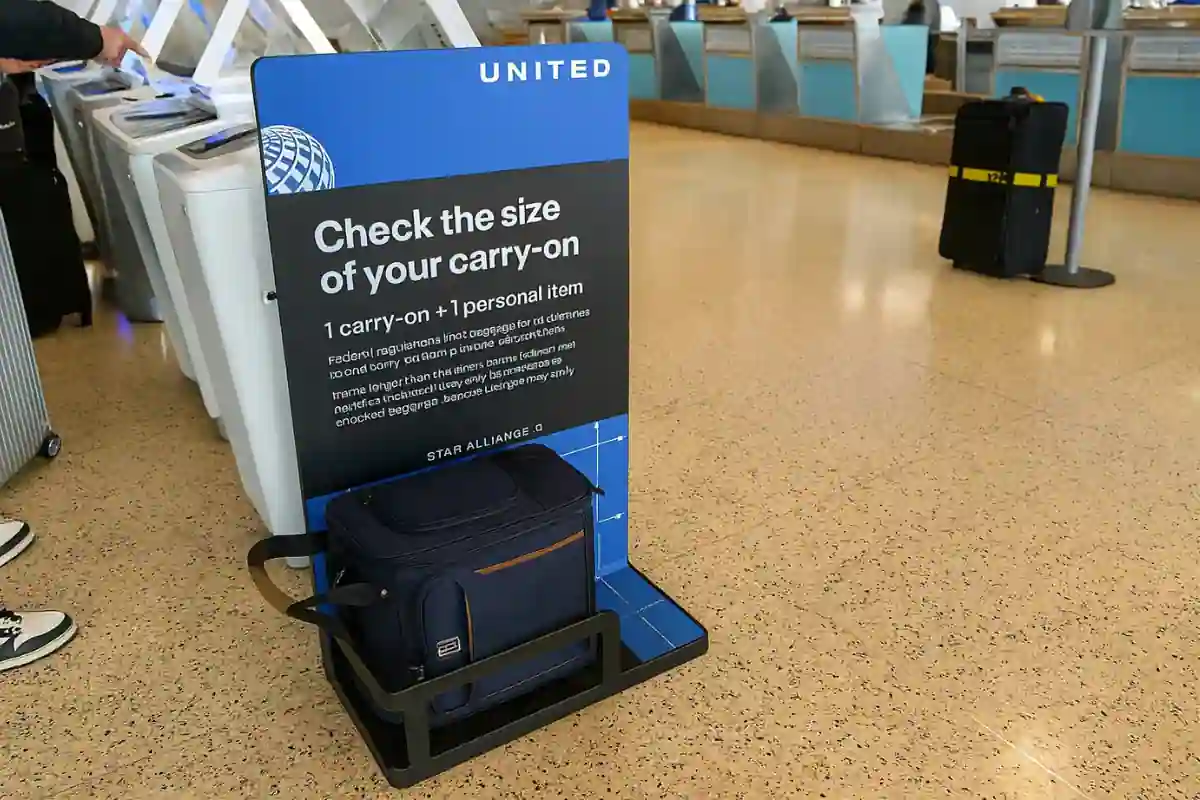
Quick Answer: Many major US airlines use 18 × 14 × 8 inches as a common personal item size, but the rules vary. United allows 17 × 10 × 9 inches, while Alaska and Southwest don’t publish exact dimensions — they just require your bag to fit under the seat (a safe estimate is around 16–17 × 13 × 8 inches). Some airlines publish specific dimensions, while others focus on under-seat fit. If your bag is too large, you may have to pay an additional baggage fee or check it at the gate. Check your airline’s current rules before flying.
Note on Spirit Airlines: Spirit Airlines permanently ceased all operations on May 2, 2026. If you’re looking for a budget airline with similar routes, Frontier and Allegiant now cover most of those markets. This guide has been updated to reflect Spirit’s shutdown.
What Counts as a Personal Item?
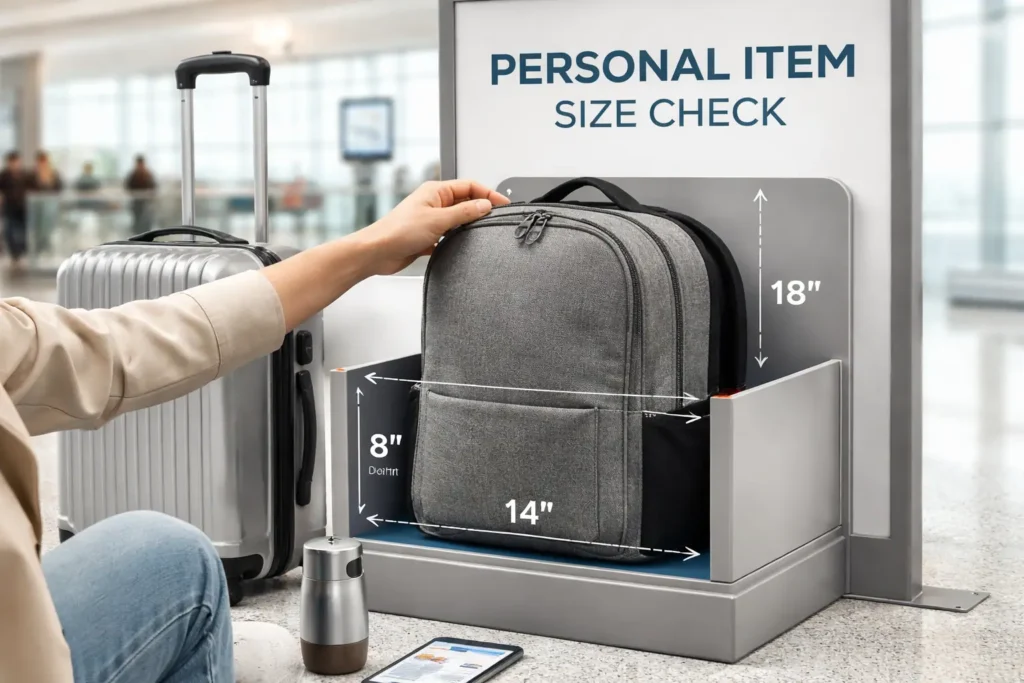
A personal item is the smaller of the two bags most airlines let you bring into the cabin for free. It goes under the seat in front of you — not in the overhead bin. Think backpacks, tote bags, laptop bags, small duffels, and purses.
| Personal Item | Carry-On | |
|---|---|---|
| Where it goes | Under the seat | Overhead bin |
| Typical size limit | ~18 x 14 x 8 in | ~22 x 14 x 9 in |
| Cost | Free on all fare types | Free on full-service; $30–$80 on budget airlines |
| Examples | Backpack, tote, laptop bag | Rolling suitcase, large duffel |
This distinction matters most because of fare class. On Basic Economy at American, Delta, United, and JetBlue, you’re only guaranteed a personal item — no overhead bin access at all.
Book one of those fares without knowing that, and your carry-on either gets checked at the gate for a fee, or you pay to upgrade your ticket.
2026 Personal Item Size Chart: Every Major US Airline
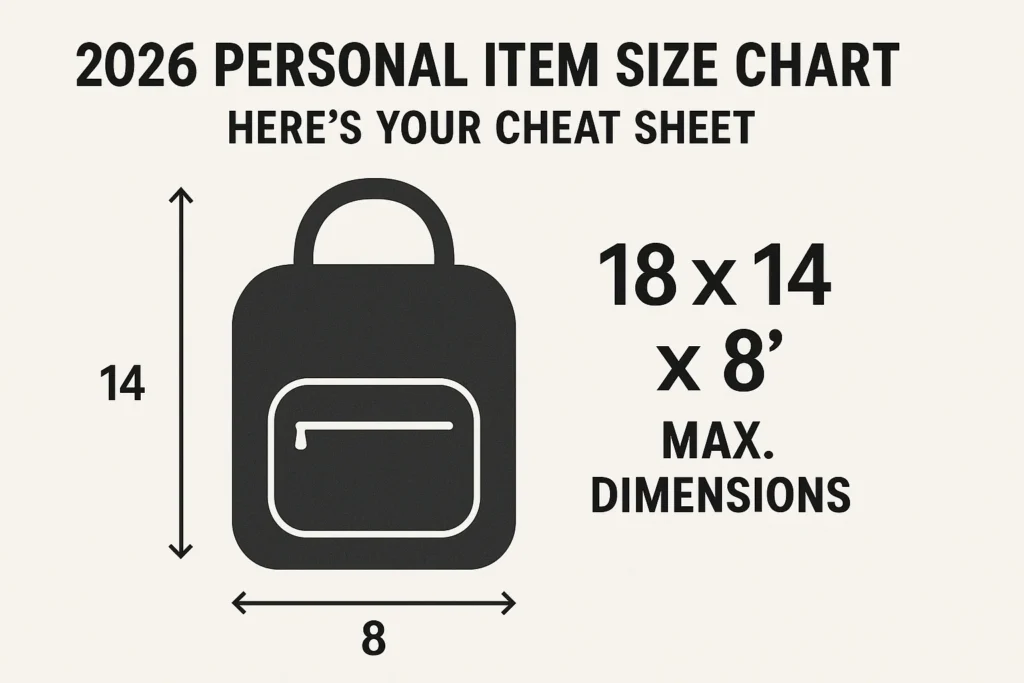
All measurements are length x width x height, in inches and centimeters.
| Airline | Max Size (in) | Max Size (cm) | Enforcement | Gate Fee If Over |
|---|---|---|---|---|
| American Airlines | 18 x 14 x 8 | 45.7 x 35.6 x 20.3 | 🟢 Easy | ~$65 |
| Delta Air Lines | 18 x 14 x 8 | 45.7 x 35.6 x 20.3 | 🟢–🟡 Easy/Medium | ~$65 |
| JetBlue Airways | 17 x 13 x 8 | 43.2 x 33 x 20.3 | 🟠 Medium/Strict | ~$65 |
| United Airlines | 17 x 10 x 9 | 43.2 x 25.4 x 22.9 | 🟡 Medium | ~$65 |
| Alaska Airlines | No official size published — est. 17 x 13 x 8* | No official size published — est. 43 x 33 x 20* | 🟡 Medium | ~$65 |
| Southwest Airlines | No official size published — est. 16 x 13 x 8* | No official size published — est. 41 x 33 x 20* | 🟡 Medium (tightening) | $35 (check fee) |
| Frontier Airlines | 18 x 14 x 8 | 45.7 x 35.6 x 20.3 | 🔴 Strict | $100 |
| Allegiant Air | 16 x 15 x 7 | 40.6 x 38.1 x 17.8 | 🔴 Strict | $50–$75 |
| Sun Country Airlines | 17 x 13 x 9 | 43.2 x 33 x 22.9 | 🟡 Medium | ~$65 |
| Avelo Airlines | 17 x 13 x 9 | 43.2 x 33 x 22.9 | 🔴 Strict | ~$65 |
| Breeze Airways | 17 x 13 x 8 | 43.2 x 33 x 20.3 | 🟡 Medium | ~$60 |
| Contour Airlines | 17 x 10 x 9 | 43.2 x 25.4 x 22.9 | 🟡 Medium | ~$60 |
Estimated size, not an official airline-published spec. See the Alaska and Southwest sections below for sourcing.
These numbers come from official airline policies. Rules and size limits can change at any time — always check your exact fare and route before you fly.
The Max Safe Size: One Bag That Works Everywhere
If you want a single bag that clears every airline in the chart above with zero risk, you have to respect the strictest limit on each dimension individually — length, width, and depth each come from a different airline:
- Absolute Max Safe Size: 16 x 10 x 6 inches (41 x 25 x 15 cm) — built from Allegiant’s 16-inch length limit, United and Contour’s 10-inch width limit, Alaska’s estimated 6–8-inch depth range combined. (Note: since Alaska doesn’t publish an official depth, this figure is a conservative estimate, not a guaranteed-safe number.)
That’s genuinely narrow — most travel backpacks are wider than 10 inches — which is why it’s worth having a practical fallback too:
- Practical Safe Size (skip United/Contour’s narrow width): 16 x 13 x 6 inches (41 x 33 x 15 cm) — this clears every airline except United and Contour’s 10-inch width rule, which is enforced inconsistently in practice compared to Alaska’s estimated depth or Allegiant’s overall size.
If you mostly fly full-service carriers like American or Delta, you don’t need to pack this conservatively at all — you have up to 18 x 14 x 8 inches of room.
The tight numbers above are only relevant if you regularly mix in United, Alaska, or Allegiant flights and want one bag that works on all of them without a second thought.
For a ready-made list of bags tested against these limits, see our 7 Best Under-Seat Bags, Tested on 20 Airlines.
How to Beat Strict Sizers: Three Things That Matter More Than the Tag
Airlines don’t just check the number on your bag’s tag — gate agents and sizer cages respond to how the bag actually behaves in three dimensions. Here’s what consistently makes the difference:
1. Soft-sided bags have an edge over rigid ones. A hard-shell or heavily structured backpack that measures exactly 18 x 14 x 8 inches can still get flagged if it can’t compress at all when pushed into a sizer cage. A soft backpack or duffel at roughly 17 x 13 x 7 inches often clears the same cage more easily, because it flexes under light pressure instead of hitting a hard edge.
2. The width is usually the real trap, not the height. United’s 10-inch width limit (shared by Contour) fails more travelers than any other single number in this guide, because most everyday backpacks are built 12–13 inches wide by default. If you fly these airlines often, look specifically for a slim-profile bag — around 17 x 10 x 9 inches — rather than assuming any “compact” backpack will do.
3. Volume in liters is a better gut-check than inches. Once a bag is fully packed, liters tell you more about real-world fit than the tag dimensions do:
- 16–20L: almost always safe as a personal item on US and most international airlines
- 20–25L: still generally fine, but only if the bag is soft-sided and under-packed enough to compress
- 25L+: high risk on any strict budget carrier, regardless of what the listed dimensions say
Always measure a bag fully packed, including anything bulging in side pockets — that’s the shape a gate agent actually sees, not the flat, empty dimensions on the product page.
Weight Limits: The Rule Most People Forget
Most of this guide focuses on size because that’s what trips people up most often — but weight matters too, and the rules aren’t consistent across carriers:
- Most U.S. airlines care more about size than weight for personal items and carry-ons, and don’t enforce a specific weight cap at the gate.
- Some international carriers apply weight limits even to personal items, sometimes as low as 15–22 lb (see our Delta international weight limits for an example on select Asia-Pacific routes).
- Hawaiian Airlines applies a firmer total weight cap than most domestic U.S. carriers — worth checking directly if you’re flying with a fully loaded bag.
A personal item might be free, but a heavy one can still cause problems if a gate agent decides to weigh it, especially on international routes.
Every Major US Airline, Ranked by Enforcement
1. American Airlines — The Most Relaxed Major Carrier
Size limit: 18 x 14 x 8 in · Enforcement: 🟢 Easy
American has the most generous personal item allowance of any major US carrier and is also the most relaxed about enforcing it — gate agents typically do a visual check rather than a sizer measurement.
On Basic Economy, though, you get only a personal item, no overhead bin, so packing it well still matters.
What fits comfortably: a 20–25L backpack, a 15″ laptop, a day or two of rolled clothing, and a toiletry pouch.
Need more details? Our American Airlines Baggage Guide we explains carry-on rules, personal item limits, checked bag fees, and what to expect on Basic Economy.
2. Delta Air Lines — Nearly Identical to American
Size limit: 18 x 14 x 8 in · Enforcement: 🟢–🟡 Easy to Medium
Delta’s dimensions match American’s exactly, and enforcement is usually just as relaxed — though it can tighten on busy routes through Atlanta, JFK, or LAX. Delta Basic Economy follows the same personal-item-only rule as American.
See our Delta Air Lines Baggage Guide 2026 for everything you need to know about carry-on sizes, personal items, and baggage fees before you fly.
3. JetBlue Airways — Good Policy, Watch the Fare Class
Size limit: 17 x 13 x 8 in · Enforcement: 🟠 Medium to Strict
JetBlue’s dimensions are a notch smaller than American and Delta’s. Blue Basic restricts you to a personal item only, and JetBlue’s gate agents are noticeably more active about measuring bags than the legacy carriers.
4. United Airlines — The 10-Inch Width Catches People Off Guard
Size limit: 17 x 10 x 9 in · Enforcement: 🟡 Medium
Most popular travel backpacks run 12–13 inches wide, which technically doesn’t comply with United’s 10-inch limit. Enforcement is inconsistent, but it’s worth knowing before you show up with a wide backpack, especially on Basic Economy fares.
United’s baggage policy is a little different. Our United Airlines Baggage Guide covers carry-on rules, the narrower personal item limit, and tips to avoid gate fees.
If you’re looking for a bag that fits that 17×10×9 personal item limit, see our 7 Best 17×10×9 Personal Item Bags for United Airlines 2026.
5. Alaska Airlines — The 6-Inch Depth Nobody Expects
Size limit: No official dimensions published — estimated safe size 17 x 13 x 8 in · Enforcement: 🟡 Medium
Alaska doesn’t publish an exact personal item size on its own baggage policy page — the only official rule is that it must fit under the seat in front of you. Third-party estimates put a safe size at roughly 17 x 13 x 8 inches, but treat this as a guideline, not a guarantee.
Because there’s no official sizer spec, enforcement tends to come down to visual/physical fit rather than a strict measured cage, which is why a slim, soft-sided bag is your safest bet on Alaska regardless of the exact number on the tag.
6. Southwest Airlines — Smaller Than Most People Assume
Size limit: No official dimensions published — estimated safe size 16 x 13 x 8 in · Enforcement: 🟡 Medium (tightening)
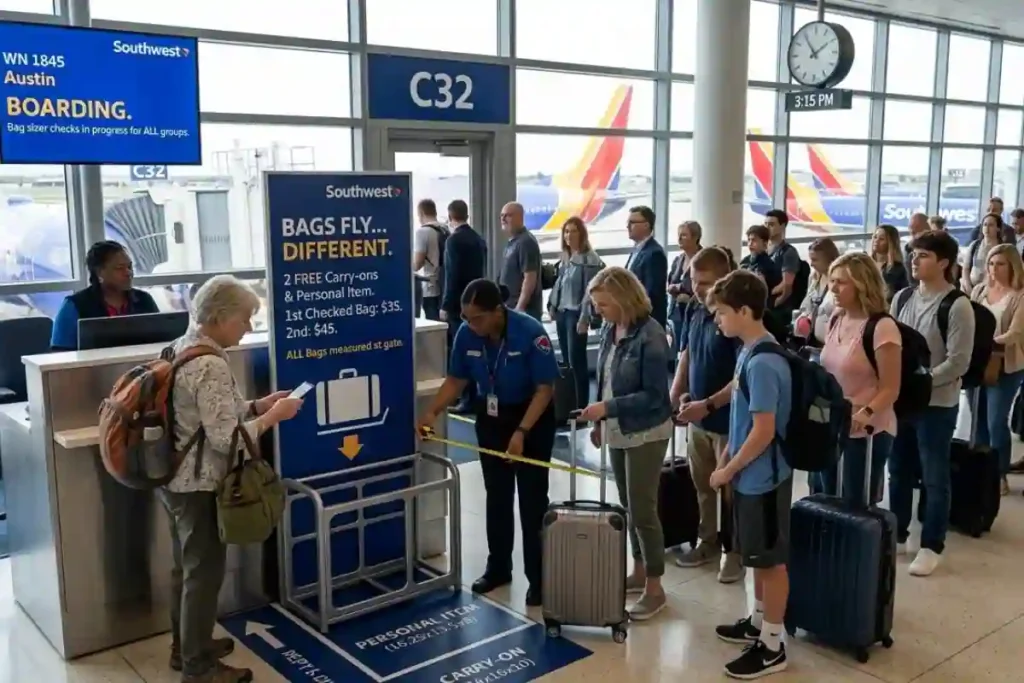
Southwest ended its “Bags Fly Free” policy for checked bags on May 28, 2025 — checked bags now cost $45 for the first and $55 for the second.
Carry-ons and personal items are still free, but Southwest doesn’t publish an exact personal item spec either it only requires the item to fit under the seat. Third-party sources put a safe working size around 16 x 13 x 8 inches, and enforcement at busy airports (Denver, Baltimore, Orlando) has tightened since the checked-bag policy changed.
Read our Southwest Airlines Baggage Guide 2026 to see the latest carry-on rules, personal item limits, and checked baggage changes before your trip.
7. Frontier Airlines — The Strictest Active Budget Carrier
Size limit: 18 x 14 x 8 in · Enforcement: 🔴 Strict · Gate fee: $100
Frontier has personal item sizers at most gates and uses them. The dimensions match American’s on paper, but the in-person experience is completely different. Always buy any bag upgrades online before you fly — Frontier’s online prices run dramatically cheaper than gate prices.
Flying Frontier? Before you pack, check our Frontier Airlines Baggage Guide 2026 to learn how its strict personal item rules and carry-on fees could affect your trip.
8. Allegiant Air — The Smallest Free Allowance in the US
Size limit: 16 x 15 x 7 in · Enforcement: 🔴 Strict
Allegiant has the tightest free personal item allowance of any major US airline. Before booking on a cheap base fare, add up the real total cost with whatever bags you’ll need — a $59 Allegiant fare with a carry-on added often ends up costing more than a $149 fare on an airline that doesn’t charge for bags.
9–12. Regional and Growing Carriers: Sun Country, Avelo, Breeze, Contour
These smaller carriers are gaining route share in 2026 and are worth knowing if you fly secondary airports:
- Sun Country (17 x 13 x 9 in) has a bit more depth than most budget carriers, giving slightly more packing flexibility.
- Avelo (17 x 13 x 9 in) enforces strictly — treat it like Frontier, not like Southwest.
- Breeze (17 x 13 x 8 in) sits in the middle of the pack for both size and enforcement.
- Contour (17 x 10 x 9 in) shares United’s narrow 10-inch width — the same wide-backpack trap applies.
Which Bag Fits Which Airline
Trying to find one bag for every airline you fly is where most travelers go wrong — the 12 airlines above fall into four distinct size profiles, and a bag built for one profile can fail on another even though both are technically “personal item size.”
| Profile | Airlines | What to Look For |
|---|---|---|
| Generous (18 x 14 x 8) | American, Delta, Frontier | Most standard personal item bags fit here. The MATEIN Personal Item Backpack is built to exactly 18 x 14 x 8 in — see our full MATEIN review. |
| Mid-size (17 x 13 x 8–9) | JetBlue, Southwest, Breeze, Sun Country, Avelo | Slightly narrower than the generous group. A soft-sided bag that compresses an inch or two of width gives the most margin — see our Best Under-Seat Bags, Tested on 20 Airlines for options verified against this range. |
| Narrow (17 x 10 x 9) | United, Contour | The 10-inch width is the trap — most travel backpacks run 12–13 inches wide. Look specifically for slim-profile laptop bags rather than general daypacks. |
| Shallow (no official spec, 17 x 13 x 8 estimated) or Tightest (16 x 13–15 x 7) | Alaska, Allegiant | Depth is the constraint here, not length or width. A flat, structured bag — not a puffy or overstuffed one — is essential. Our Best Underseat Luggage With Wheels guide covers a few slim-profile rolling options tested against these tighter limits. |
If you fly a mix of these airlines and want a single bag that never gets flagged, go back to the Max Safe Size (16 x 13 x 6 in) above — it’s built around exactly this Alaska/Southwest overlap.
Five Mistakes That Lead to Gate Fees
1. Assuming all airlines have the same rules. United’s 10-inch width is significantly narrower than American’s 14 inches. Alaska’s shallow under-seat space catches people who’ve never flown it before — and since Alaska doesn’t publish an exact number, it’s easy to assume your bag is fine when it isn’t. A bag that clears Delta for years might not pass Alaska’s sizer.
2. Packing until the bag is visibly stuffed. Technically-within-dimensions-but-visibly-overstuffed still gets flagged. Gate agents look at shape, not just numbers. Pack to about 85% capacity.
3. Not checking what’s under your seat. Newer aircraft, especially the A321neo, have entertainment system boxes and floor beams under certain seats that reduce usable under-seat space. Check SeatGuru before you fly if you’re carrying a full personal item.
4. Booking Basic Economy without knowing what it includes. Basic Economy at American, Delta, United, and JetBlue means personal item only. Show up with a carry-on anyway, and that’s where the expensive surprise happens.
5. Trusting marketing language over actual measurements. “Travel bag,” “airline-approved,” and “cabin-size” aren’t regulated terms. Always check the bag’s actual dimensions against your specific airline’s policy page. This matters most on Alaska and Southwest specifically — since neither publishes an exact spec, a product listed as “Alaska-approved” or “Southwest-approved” is going off someone’s estimate, not an official airline number.
How Frequent Flyers Avoid Bag Fees
- Measure before you leave home — tape measure, actual numbers, including exterior pockets and handles.
- Test at the airport sizer before your gate — most airports have sizing boxes near check-in, with none of the boarding-time pressure.
- Buy Frontier or Allegiant bag upgrades online the night before — online prices are always cheaper than gate prices.
- Get an airline credit card if you fly the same carrier regularly — Delta SkyMiles Gold, United Explorer, and similar cards typically include a free first checked bag, which can cover the annual fee in one trip.
- Compare total cost, not base fare — on Frontier or Allegiant, add the bag fees before comparing to a full-service airline’s all-in price.
Quick Pre-Flight Checklist for 2026
- ✅ Measure your bag fully packed — not empty — including anything bulging in side pockets
- ✅ Include wheels and handles in the measurement if your bag has them
- ✅ Compare against your specific airline’s row in the chart above, not a generic “carry-on size” label
- ✅ If you fly multiple airlines, pack toward the Practical Safe Size (16 x 13 x 6 in) rather than your most generous airline’s limit
- ✅ Keep your passport, ID, and boarding pass in an easy-to-reach front pocket for security
- ✅ If your bag looks tight, carry heavier items (laptop, book) in hand while boarding and repack once seated
What is the standard personal item size for US airlines in 2026?
The most common limit is 18 x 14 x 8 inches, used by American, Delta, and Frontier. United uses 17 x 10 x 9 (watch the narrow width), Alaska doesn’t publish an exact size — estimate around 17 x 13 x 8 (watch the shallow depth), and Southwest uses an estimated 16 x 13 x 8, since it also has no official published spec.
Does a backpack count as a personal item?
Yes. As long as it fits within your airline’s size limit and slides under the seat, a backpack qualifies as a personal item and flies free on every major US carrier.
What’s the difference between a carry-on and a personal item?
A personal item goes under the seat (typically up to 18 x 14 x 8 in) and is free on all fare types. A carry-on goes in the overhead bin (typically up to 22 x 14 x 9 in) and may cost extra on budget airlines or Basic Economy fares.
Which US airline allows the biggest personal item?
American and Delta both allow 18 x 14 x 8 inches and enforce it the most leniently, making them the best choice for maximizing free bag space.
Which US airline is strictest about personal item size now that Spirit has shut down?
Frontier is now the strictest active budget carrier, charging $100 at the gate for non-compliant bags. Allegiant and Avelo are close behind.
What happened to Spirit Airlines?
Spirit Airlines permanently ceased all operations on May 2, 2026. Frontier and Allegiant now cover most of the routes Spirit used to serve.
What happens if my personal item is too big?
The airline will require you to pay a carry-on or checked bag fee at the gate, typically $65–$100. These fees are consistently cheaper when purchased online in advance rather than at the gate.
Does Southwest still have free bags in 2026?
Southwest’s carry-on and personal item are still free. However, Southwest ended its “Bags Fly Free” policy for checked bags on May 28, 2025 — checked bags now cost $45 for the first and $55 for the second on most fares.
Is a 40L backpack too big for a personal item?
Almost certainly yes. A 40L backpack typically exceeds personal item dimensions on every major US airline, though it may qualify as a carry-on on some carriers.
What’s the safest bag size that works on every US airline?
For absolute safety on all 12 airlines, including United and Contour’s narrow 10-inch width, target 16 x 10 x 6 inches. Most travelers find that overly narrow — a more practical 16 x 13 x 6 inches clears every airline except United and Contour, whose width limit is enforced less consistently than Alaska’s depth rule.
Sources: Bureau of Transportation Statistics, US Department of Transportation, individual airline official baggage policy pages. Verified July 2026. Alaska and Southwest personal item figures are third-party estimates, not confirmed by the airlines’ own published policies as of September 2026. Airline dimensions and fees change — always confirm on your airline’s website before you fly.
Related guides:
- New Carry-On Rules in 2026: What Every Traveler Must Know Before They Fly
- 7 Best Under-Seat Bags — Tested on 20 Airlines
- Backpack vs Handbag as Personal Item: Which Airlines Prefer?
- The Best Carry-On Luggage with Laptop Compartments in 2026 — Tested for Real Travel
- TSA Wearable Device Rules 2026: Apple Watch, CGM, Insulin Pump, Smart Ring — Everything You Need Before You Fly
