

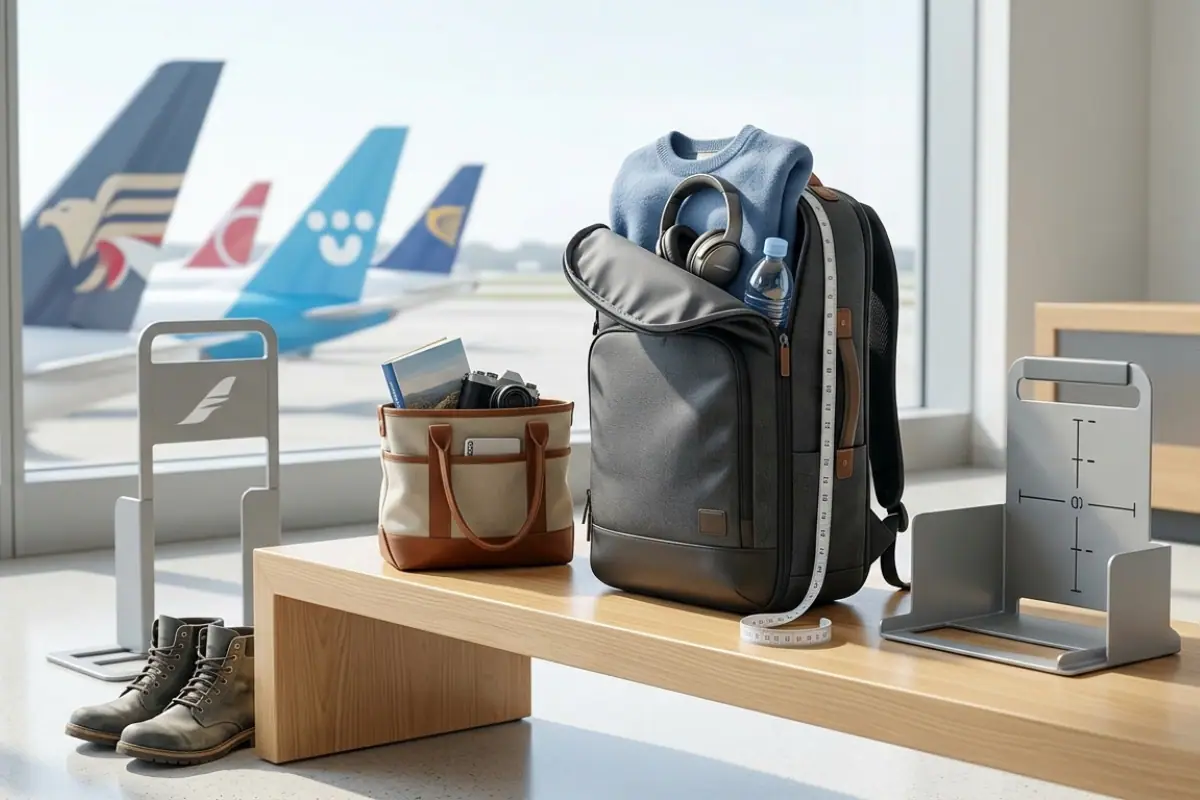
Quick answer: Most major US airlines allow an 18 × 14 × 8 inch personal item — but at least 3 airlines quietly use smaller dimensions, and one of them shaves off nearly half the depth. Guess wrong and you’re paying a $65–$100 gate fee with your flight already boarding. Full airline-by-airline breakdown (with exact numbers) is below.
Personal Item Size Cheat Sheet (2026)
| Airline | Personal Item Max Size | Free? |
|---|---|---|
| American Airlines | 18″ × 14″ × 8″ | ✅ Yes |
| Delta Air Lines | 18″ × 14″ × 8″ | ✅ Yes |
| JetBlue Airways | 17″ × 13″ × 8″ | ✅ Yes |
| United Airlines | 17″ × 10″ × 9″ | ✅ Yes |
| Alaska Airlines | 17″ × 13″ × 6″ | ✅ Yes |
| Southwest Airlines | 16.25″ × 13.5″ × 8″ | ✅ Yes |
| Frontier Airlines | 18″ × 14″ × 8″ | ✅ Yes (strictly enforced) |
| Allegiant Air | 16″ × 15″ × 7″ | ✅ Yes (smallest allowance) |
Note on Spirit Airlines: Spirit Airlines permanently ceased all operations on May 2, 2026. If you’re looking for a budget airline with similar routes, Frontier and Allegiant now cover most of those markets.
The Gate Fee Nobody Warns You About
Let me tell you what actually happens when a gate agent flags your bag.
You’re already at the gate. Your flight is boarding. You’ve been traveling for two hours. And then someone in a uniform points at your bag and says it needs to go under the seat — and it won’t fit — which means it’s now a carry-on — which means you owe $99 right now, card only, no exceptions.
That’s not a hypothetical. That’s Tuesday at any Frontier terminal in the US.
US airlines collected $7.27 billion in baggage fees in 2024. That number goes up every year. Airlines aren’t stupid — they know most travelers assume their bag will be fine, and they’ve built revenue systems around that assumption.
The fix is pretty simple: know your airline’s actual dimensions before you pack, not after you’re standing at the gate. That’s what this guide is for.
What Even Is a Personal Item?
A personal item is the smaller of the two bags you’re allowed to bring on board. It goes under the seat in front of you — not in the overhead bin. Think backpacks, tote bags, laptop bags, small duffels, purses.
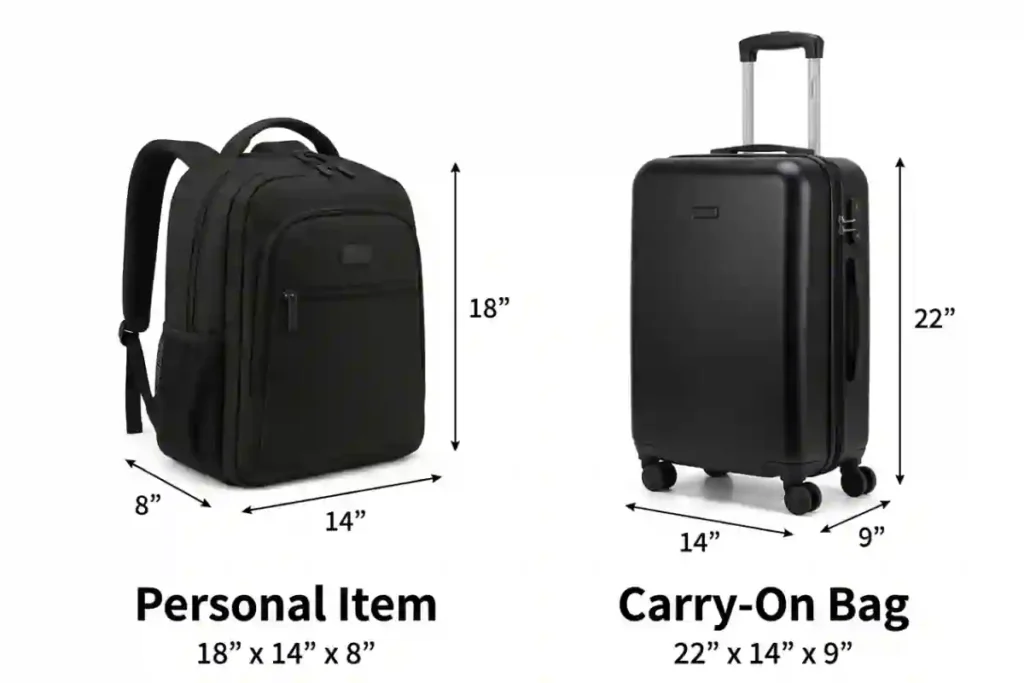
Here’s the distinction most people miss:
| Personal Item | Carry-On | |
|---|---|---|
| Where it goes | Under the seat | Overhead bin |
| Typical size limit | ~18″ × 14″ × 8″ | ~22″ × 14″ × 9″ |
| Cost | Free on all fare types | Free on full-service; $30–$80 on budget airlines |
| Examples | Backpack, tote, laptop bag | Rolling suitcase, large duffel |
The reason this matters so much is fare class. On Basic Economy at American, Delta, United, and JetBlue, you’re only allowed a personal item — no overhead bin access at all.
Book one of those fares without knowing that, and your carry-on suitcase either gets checked at the gate (for a fee) or you pay to upgrade your ticket.
Every Major US Airline, Ranked
1. American Airlines — The Most Relaxed Major Carrier
Size limit: 18″ × 14″ × 8″ Enforcement: 🟢 Easy
American has the most generous personal item allowance of any major US carrier, and they’re also the most relaxed about enforcing it.
Gate agents typically do a visual check, not a sizer measurement. I’ve traveled with a packed 25L Osprey Daylite on American multiple times without a second glance.
That said — if you’re on Basic Economy, you get only a personal item. No overhead bin. So packing that personal item well still matters.
What fits comfortably:
- 20–25L backpack
- 15″ laptop + charger + accessories
- A day or two of clothes (rolled)
- Toiletry pouch + snacks + headphones
Practical tip: A slim 25L daypack works perfectly here. It maxes out the allowed space without ever looking like you’re pushing it.
2. Delta Air Lines — Almost As Good As American
Size limit: 18″ × 14″ × 8″ Enforcement: 🟢–🟡 Easy to Medium
Delta’s dimensions are identical to American’s, and enforcement is similar — usually relaxed, occasionally tighter on busy routes out of Atlanta, JFK, or LAX. The more packed the flight, the more likely an agent pays attention.
Delta Basic Economy is the same story as American — personal item only, no overhead access.
Worth knowing: Delta’s SkyMiles Gold credit card includes a free first checked bag for you and a companion. If you fly Delta more than twice a year, that card usually pays for itself on the first trip.
See our – Delta Air Lines Baggage Guide 2026: Carry-On Rules, Fees & Personal Item Size
3. JetBlue Airways — Good Policy, Just Watch the Fare Class
Size limit: 17″ × 13″ × 8″ Enforcement: 🟠 Medium to Strict
JetBlue’s dimensions are slightly smaller than American and Delta — you lose an inch of length and width — but it’s still reasonable.
The bigger issue is their Blue Basic fare, which restricts you to a personal item only, and their gate agents are noticeably more active about measuring bags than the legacy carriers.
JetBlue also introduced dynamic pricing for checked bags in 2025, which has pushed more travelers to maximize their personal item — which in turn has pushed agents to watch those bags more carefully. Just be aware of that cycle on busy JetBlue routes.
Practical tip: Keep your bag structured, not stuffed. A bag with a clean shape gets waved through. A bag that’s visibly straining at the seams invites a second look.
4. United Airlines — That 10-Inch Width Will Surprise You
Size limit: 17″ × 10″ × 9″ Enforcement: 🟡 Medium
United’s dimensions look similar to everyone else on paper until you see that 10-inch width. Most popular travel backpacks run 12–13 inches wide — which technically doesn’t comply. Enforcement is inconsistent, but it’s worth being aware of on packed flights and United Basic Economy fares.
If you fly United Basic Economy regularly, it’s worth finding a bag designed specifically around these dimensions. The slim profile laptop bags from brands like Aer, Bellroy, or Tom Bihn fit United’s specs well.
Practical tip: If your bag is borderline on United, a window seat usually has a bit more under-seat space than middle or aisle seats. Worth keeping in mind when you select your seat.
Flying United specifically? Our United Airlines Baggage Rules 2026 guide breaks down the 17×10×9 personal-item limit, why the 10-inch width matters, and what Basic Economy actually includes. If you’re shopping for a bag that fits those dimensions, see our 7 Best 17×10×9 Personal Item Bags for United Airlines 2026.
5. Alaska Airlines — The 6-Inch Depth Nobody Expects
Size limit: 17″ × 13″ × 6″ Enforcement: 🟡 Medium
Alaska’s total cubic inches are actually comparable to other airlines — but all of it is front-to-back depth, and 6 inches is seriously thin. A standard daypack or anything with a bit of puffiness to it won’t fit that profile, even if the length and width are fine.
This is the airline that catches people most off guard, because most travelers only check the headline dimensions without noticing the depth limit.
What works: Slim laptop bags, structured totes, flat daypacks. Brands like Tortuga, Aer, and Peak Design make bags specifically designed for tight depth restrictions.
6. Southwest Airlines — Not What It Used to Be
Size limit: 16.25″ × 13.5″ × 8″ Enforcement: 🟡 Medium (tightening)
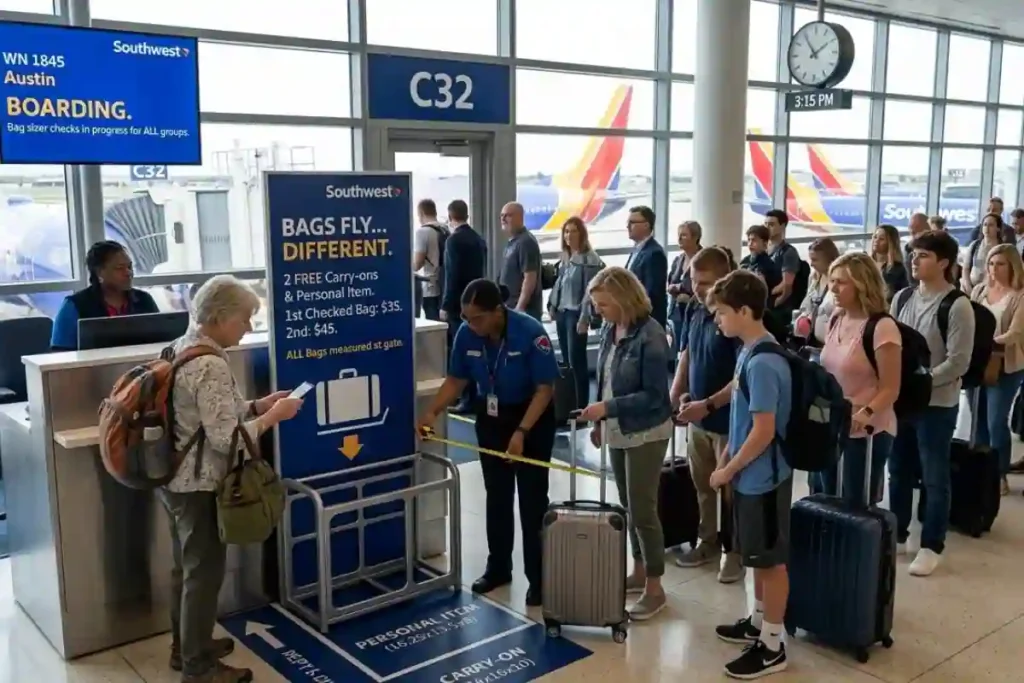
Two things happened to Southwest in 2025 that changed how travelers should think about it.
First, Southwest ended its famous “Bags Fly Free” policy on May 28, 2025. Checked bags now cost $35 for the first and $45 for the second. Carry-ons and personal items are still free, but the era of Southwest being a no-brainer choice for bag-heavy travelers is over.
Second, Southwest’s personal item dimensions are smaller than most people assume — 16.25 × 13.5 × 8 inches. That’s notably tighter than American or Delta.
And enforcement at busy Southwest airports (Denver, Baltimore, Orlando) has gotten stricter since the checked bag policy changed — more travelers are trying to stuff everything into a personal item, and agents are responding.
Practical tip: If your usual bag fits perfectly on American, measure it carefully before assuming it’ll pass on Southwest. And use a soft-sided bag — something that can compress slightly if it’s borderline.
7. Frontier Airlines — The Strictest Active Budget Carrier
Size limit: 18″ × 14″ × 8″ Gate fee if caught: $100 Enforcement: 🔴 Strict
Frontier brought in $861.6 million in baggage fees in 2024. That revenue doesn’t come from nowhere — it comes from passengers who didn’t buy bag upgrades in advance and got charged at the gate.
Frontier has personal item sizers at many gates, and their agents use them. Same dimensions as American on paper, completely different experience in practice. A bag that would get waved through at American’s gate will get measured at Frontier’s.
The most important thing to know about Frontier: Always — always — buy any bag upgrades online before you fly. Frontier’s online bag prices are dramatically cheaper than gate prices. If there’s any chance your bag is borderline, pay the upgrade fee the night before. It could be the difference between $25 online and $100 at the gate.
8. Allegiant Air — The Smallest Free Allowance in the US
Size limit: 16″ × 15″ × 7″ Enforcement: 🔴 Strict
Allegiant has the most restrictive free personal item allowance of any major US airline. Their entire business model is built around low base fares plus add-on fees for everything, and baggage is a primary revenue line.
Before you book Allegiant because the base fare looks cheap — add up the actual total cost with whatever bags you need. A $59 Allegiant fare with a carry-on added often costs more than a $149 Southwest or American fare that doesn’t charge for bags at all.
Full 2026 Comparison Table
| Airline | Size (L × W × H) | Strictness | Gate Fee If Over |
|---|---|---|---|
| American | 18″ × 14″ × 8″ | 🟢 Easy | ~$65 |
| Delta | 18″ × 14″ × 8″ | 🟢–🟡 Easy/Med | ~$65 |
| JetBlue | 17″ × 13″ × 8″ | 🟠 Med/Strict | ~$65 |
| Southwest | 16.25″ × 13.5″ × 8″ | 🟡 Medium | $35 (check fee) |
| United | 17″ × 10″ × 9″ | 🟡 Medium | ~$65 |
| Alaska | 17″ × 13″ × 6″ | 🟡 Medium | ~$65 |
| Frontier | 18″ × 14″ × 8″ | 🔴 Strict | $100 |
| Allegiant | 16″ × 15″ × 7″ | 🔴 Strict | $50–$75 |
Rankings: Best to Worst for Personal Item Travelers
Most generous (size + enforcement):
- American Airlines — biggest dimensions, most relaxed
- Delta Air Lines — identical to American, similar experience
- JetBlue (non-Basic fares) — slightly smaller but reasonable
Middle of the road — know your bag: 4. United Airlines — watch that 10-inch width 5. Alaska Airlines — the 6-inch depth is the trap 6. Southwest Airlines — smaller than expected, enforcement tightening
Pack precisely or pay: 7. Frontier Airlines — same dims as American, completely different enforcement 8. Allegiant Air — smallest allowance, budget accordingly
What Actually Fits in a Personal Item
Here are two setups I’ve used personally — both work reliably.
The Carry-Everything Setup (~25L, 18″ × 12″ × 8″)
Works on: American, Delta, JetBlue, Frontier (if packed carefully)
- 15″ laptop in padded sleeve
- Tablet or e-reader
- Phone charger + power bank + cable
- Noise-canceling headphones
- 1–2 days of clothes rolled tight
- TSA toiletries pouch
- Snacks + collapsible water bottle
- Light packable jacket
The key to making this work is packing to about 85% capacity. A bag that looks structured and controlled doesn’t get measured. A bag that’s straining at every seam does.
The Minimalist Laptop Setup (~15L, 17″ × 12″ × 5″)
Works on every US airline, including Alaska and Allegiant
- 13–15″ laptop + charger
- Mouse + accessories
- Headphones
- Notebook
- Medications, wallet, travel documents
- Snacks
This is the safest setup if you’re hopping between airlines or aren’t sure about enforcement. It clears every sizer on every airline with room to spare.
Five Mistakes That Lead to Gate Fees
1. Assuming all airlines have the same rules
They don’t. United’s 10-inch width is significantly narrower than American’s 14 inches. Alaska’s 6-inch depth catches people who’ve never flown it before. A bag you’ve used on Delta for two years might not pass Alaska’s sizer. Check your specific airline every time — rules also change.
2. Packing until the bag is visibly stuffed
Technically within dimensions, visibly overstuffed = still gets flagged. Gate agents look at shape, not just numbers. Pack to about 85% capacity. Leave a little room and the bag looks compliant. Max it out and it looks like a problem.
3. Not checking what’s under your seat
Newer narrow-body aircraft — especially the A321neo — have entertainment system boxes, floor beams, and power outlets under certain seats that eat into under-seat space significantly. A bag that fits fine under one seat won’t slide under another. Check SeatGuru before you fly and avoid flagged seats when you’re carrying a full personal item.
4. Booking Basic Economy without knowing what it includes
Basic Economy at American, Delta, United, and JetBlue means personal item only — no overhead bin access. A lot of people book it because it’s the cheapest option without reading what’s included. Then they show up at the gate with a carry-on. That’s where the expensive surprise happens.
5. Trusting marketing language over actual measurements
“Travel bag,” “airline-approved,” “cabin-size” — none of these terms are regulated. A bag marketed as airline-approved may not actually comply with the airline you’re flying. Always check the actual dimensions against your specific airline’s policy page. Don’t trust the product description.
How Frequent Flyers Actually Avoid Bag Fees
Measure before you leave home. Tape measure, actual numbers, include all exterior pockets, handles, and feet. Don’t eyeball it.
Test at the airport sizer before your gate. Most airports have sizing boxes near check-in. Try your bag there — it’s the same sizer, with none of the boarding-time pressure.
Buy Frontier/Allegiant upgrades online the night before. If there’s any doubt at all, the online price is always dramatically cheaper than the gate price. Just pay it.
Get an airline credit card if you fly the same carrier regularly. Delta SkyMiles Gold, United Explorer, Alaska Visa — all include a free first checked bag for you and a companion. That benefit usually covers the annual fee in one round trip.
Pack a packable tote in your carry-on. If your carry-on gets gate-checked due to overhead bin space being full, quickly move your laptop, meds, and chargers into the packable tote before they take it. The tote counts as your personal item and stays with you.
Always compare total cost, not base fare. On Frontier or Allegiant, add the bag fees before you compare to other airlines. A $79 Frontier base fare with a $79 carry-on fee each way is $316 in bags alone round-trip. A $189 American fare with no bag fees is cheaper.
Final Verdict
American Airlines is the best option if you want to maximize your personal item without stress — generous dimensions and relaxed enforcement.
Delta is essentially the same story, just slightly more variable by route.
JetBlue works well on standard fares. Watch Blue Basic.
United is fine but know the 10-inch width restriction before you show up with a wide backpack.
Alaska has an unusual 6-inch depth limit that catches travelers unfamiliar with it. Pack slim.
Southwest is no longer the baggage-free paradise it was — checked bags now cost money, and personal item enforcement has gotten stricter as a result.
Frontier enforces aggressively and charges $100 at the gate. Always upgrade online in advance if there’s any doubt.
Allegiant has the smallest free allowance of any major US carrier. Factor that into your total cost comparison before booking.
Before every single flight, check these three things:
- Your airline’s current personal item size limit (they do change)
- Your fare class (Basic Economy = personal item only on most airlines)
- Your bag’s actual measured dimensions
Do those three things and you won’t pay a surprise gate fee.
Frequently Asked Questions
What is the standard personal item size for US airlines in 2026?
The most common limit is 18 × 14 × 8 inches, used by American, Delta, and Frontier. Each major airline has slightly different rules — three airlines in particular have restrictions most travelers don’t expect. See the full comparison table above.
Does a backpack count as a personal item?
Yes, a backpack is one of the most common personal items on US flights. As long as it fits within your airline’s size limit and slides under the seat, it qualifies as a personal item and flies free on all major US carriers.
What’s the difference between a carry-on and a personal item?
A personal item goes under the seat in front of you (typically up to 18 × 14 × 8 inches) and is free on all fare types. A carry-on goes in the overhead bin (typically up to 22 × 14 × 9 inches) and may cost $30–$80+ on budget airlines or Basic Economy fares.
Which US airline allows the biggest personal item?
American and Delta both allow 18 × 14 × 8 inches and enforce it the most leniently, making them the best choice for travelers trying to maximize free bag space.
Which US airline is the strictest about personal item size now that Spirit has shut down?
Frontier is now the strictest active budget carrier. They charge $100 at the gate if your bag doesn’t comply, and they actively use sizers. Allegiant is close behind with the smallest free allowance overall.
What happened to Spirit Airlines?
Spirit Airlines permanently ceased all operations on May 2, 2026. If you’re looking for low-cost alternatives on similar routes, Frontier and Allegiant now cover most of those markets.
What happens if my personal item is too big?
The airline will require you to pay a carry-on or checked bag fee at the gate — usually $65–$100. On Frontier it’s a flat $100. These fees are always cheaper if you buy bag upgrades online before check-in, so if there’s any doubt, upgrade in advance.
Does Southwest still have free bags in 2026?
Southwest’s carry-on and personal item are still free in 2026. However, Southwest ended its famous “Bags Fly Free” policy for checked bags on May 28, 2025. Checked bags now cost $35 for the first and $45 for the second on most fare types. Elite members and credit cardholders still get free checked bags.
Is a 40L backpack too big for a personal item?
Almost certainly yes. A 40L backpack typically exceeds personal item dimensions on every major US airline. It may qualify as a carry-on (overhead bin) on some airlines but not as a personal item.
What’s the safest bag size that works on every US airline?
o clear every US airline’s personal item sizer without worry, target a bag around 16 × 13 × 6 inches or smaller. That fits Southwest’s tighter dimensions, Alaska’s depth restriction, and every budget carrier’s sizer. It’s a tight constraint — but it’s what “truly universal” means.
Sources: Bureau of Transportation Statistics, US Department of Transportation, individual airline official baggage policy pages (verified July 2026). Airline dimensions and fees change — always verify on your airline’s website before you fly.
Related guides:
